NAB Developer Guide
Acknowledgements
Original Source
- This project is based on the AddressBook-Level3 project created by the SE-EDU initiative.
- Libraries used: JavaFX, Jackson, JUnit5
AI-Assisted Work
- Google Gemini was used to generate the NAB logo for the application and the GUI window.
Setting up, getting started
Refer to the guide Setting up and getting started.
Design
Architecture
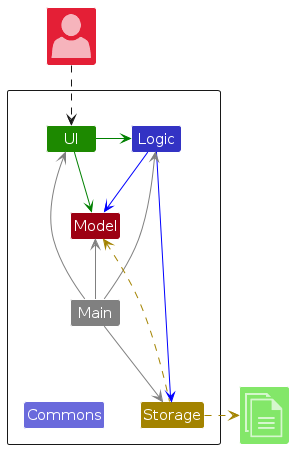
The Architecture Diagram given above explains the high-level design of the App.
Given below is a quick overview of main components and how they interact with each other.
Main components of the architecture
Main (consisting of classes Main and MainApp) is in charge of the app launch and shut down.
- At app launch, it initializes the other components in the correct sequence, and connects them up with each other.
- At shut down, it shuts down the other components and invokes cleanup methods where necessary.
The bulk of the app's work is done by the following four components:
UI: The UI of the App.Logic: The command executor.Model: Holds the data of the App in memory.Storage: Reads data from, and writes data to, the hard disk.
Commons represents a collection of classes used by multiple other components.
How the architecture components interact with each other
The Sequence Diagram below shows how the components interact with each other for the scenario where the user issues the command delete n/David.
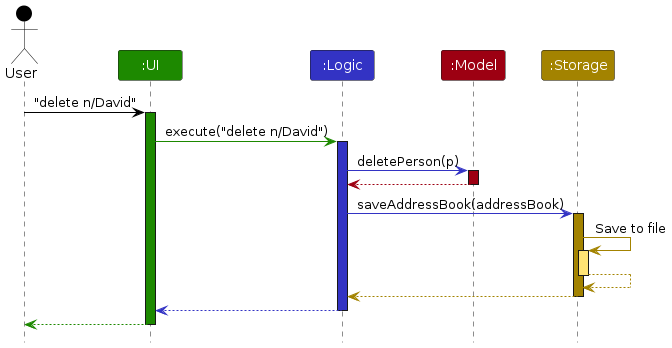
Each of the four main components (also shown in the diagram above),
- defines its API in an
interfacewith the same name as the Component. - implements its functionality using a concrete
{Component Name}Managerclass (which follows the corresponding APIinterfacementioned in the previous point.
For example, the Logic component defines its API in the Logic.java interface and implements its functionality using the LogicManager.java class which follows the Logic interface. Other components interact with a given component through its interface rather than the concrete class (reason: to prevent outside component's being coupled to the implementation of a component), as illustrated in the (partial) class diagram below.
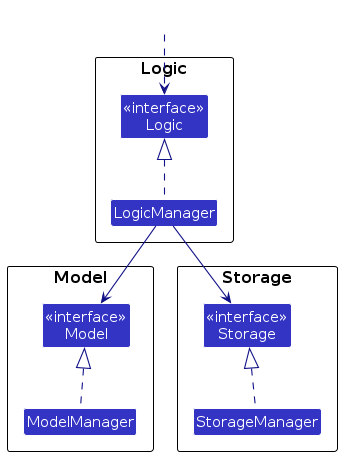
The sections below give more details of each component.
UI component
The API of this component is specified in Ui.java
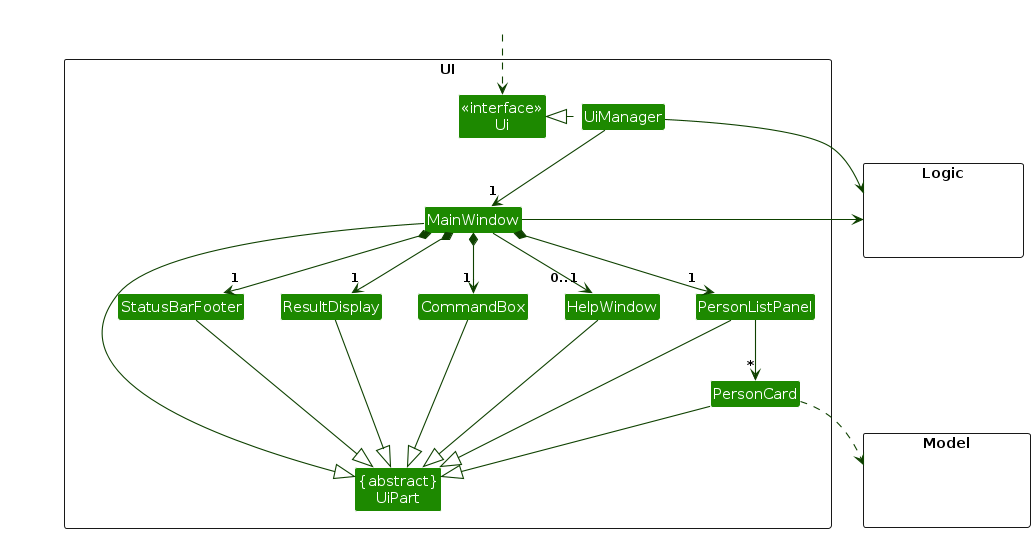
The UI consists of a MainWindow that is made up of parts e.g.CommandBox, ResultDisplay, PersonListPanel, StatusBarFooter etc. All these, including the MainWindow, inherit from the abstract UiPart class which captures the commonalities between classes that represent parts of the visible GUI.
The UI component uses the JavaFx UI framework. The layout of these UI parts are defined in matching .fxml files that are in the src/main/resources/view folder. For example, the layout of the MainWindow is specified in MainWindow.fxml
The UI component,
- executes user commands using the
Logiccomponent. - listens for changes to
Modeldata so that the UI can be updated with the modified data. - keeps a reference to the
Logiccomponent, because theUIrelies on theLogicto execute commands. - depends on some classes in the
Modelcomponent, as it displaysPersonobject residing in theModel.
Logic component
API : Logic.java
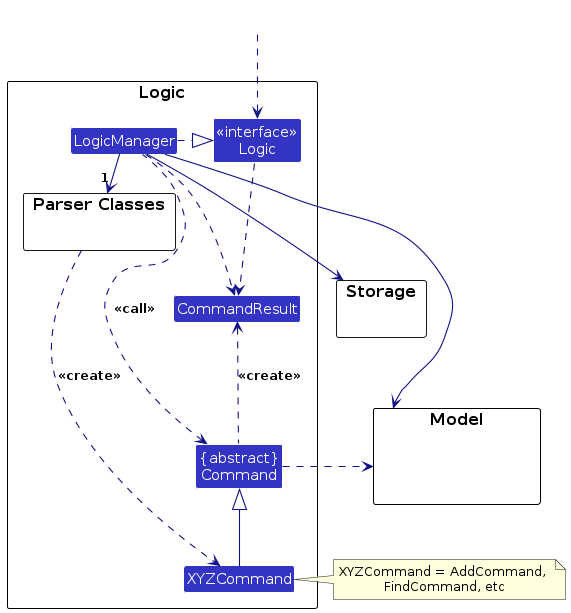
Here's a (partial) class diagram of the Logic component:
The sequence diagram below illustrates the interactions within the Logic component, taking execute("delete n/David") API call as an example.
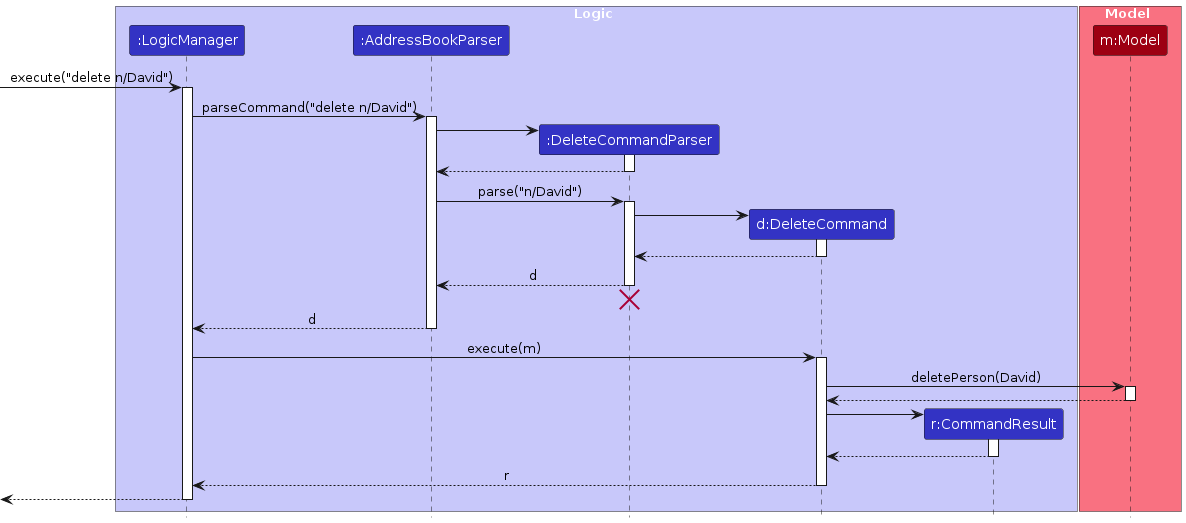
Note: The lifeline for DeleteCommandParser should end at the destroy marker (X) but due to a limitation of PlantUML, the lifeline continues till the end of diagram.
How the Logic component works:
- When
Logicis called upon to execute a command, it is passed to anAddressBookParserobject which in turn creates a parser that matches the command (e.g.,DeleteCommandParser) and uses it to parse the command. - This results in a
Commandobject (more precisely, an object of one of its subclasses e.g.,DeleteCommand) which is executed by theLogicManager. - The command can communicate with the
Modelwhen it is executed (e.g. to delete a person).
Note that although this is shown as a single step in the diagram above (for simplicity), in the code it can take several interactions (between the command object and theModel) to achieve. - The result of the command execution is encapsulated as a
CommandResultobject which is returned back fromLogic.
Here are the other classes in Logic (omitted from the class diagram above) that are used for parsing a user command:
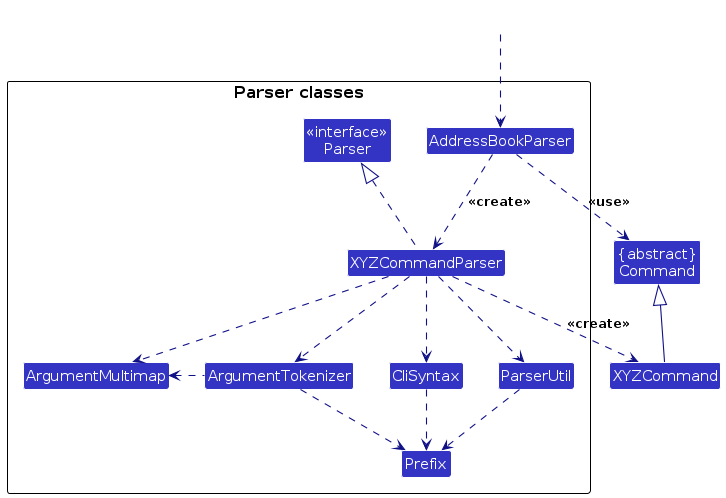
How the parsing works:
- When called upon to parse a user command, the
AddressBookParserclass creates anXYZCommandParser(XYZis a placeholder for the specific command name e.g.,AddCommandParser) which uses the other classes shown above to parse the user command and create aXYZCommandobject (e.g.,AddCommand) which theAddressBookParserreturns back as aCommandobject. - All
XYZCommandParserclasses (e.g.,AddCommandParser,DeleteCommandParser, ...) inherit from theParserinterface so that they can be treated similarly where possible e.g, during testing.
Model component
API : Model.java
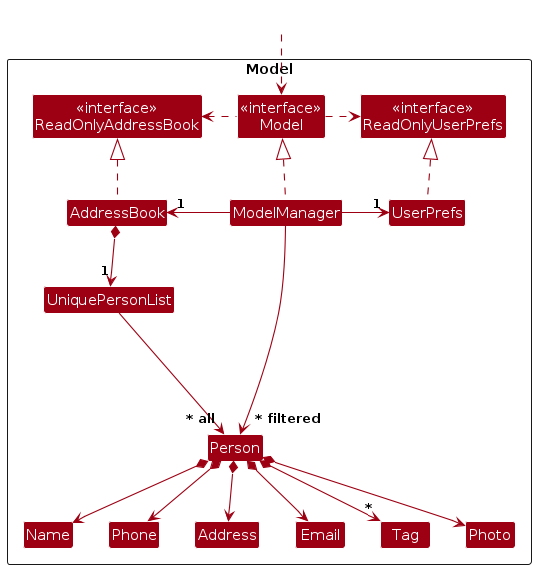
The Model component,
- stores the address book data i.e., all
Personobjects (which are contained in aUniquePersonListobject). - stores the currently 'selected'
Personobjects (e.g., results of a search query) as a separate filtered list which is exposed to outsiders as an unmodifiableObservableList<Person>that can be 'observed' e.g. the UI can be bound to this list so that the UI automatically updates when the data in the list change. - stores a
UserPrefobject that represents the user’s preferences. This is exposed to the outside as aReadOnlyUserPrefobjects. - does not depend on any of the other three components (as the
Modelrepresents data entities of the domain, they should make sense on their own without depending on other components)
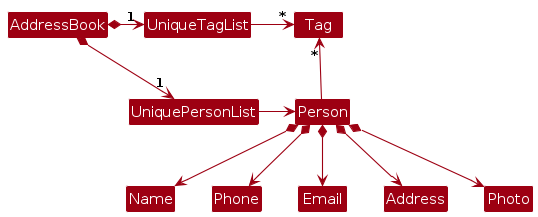
Note: An alternative (arguably, a more OOP) model is given below. It has a Tag list in the AddressBook, which Person references. This allows AddressBook to only require one Tag object per unique tag, instead of each Person needing their own Tag objects.
Storage component
API : Storage.java
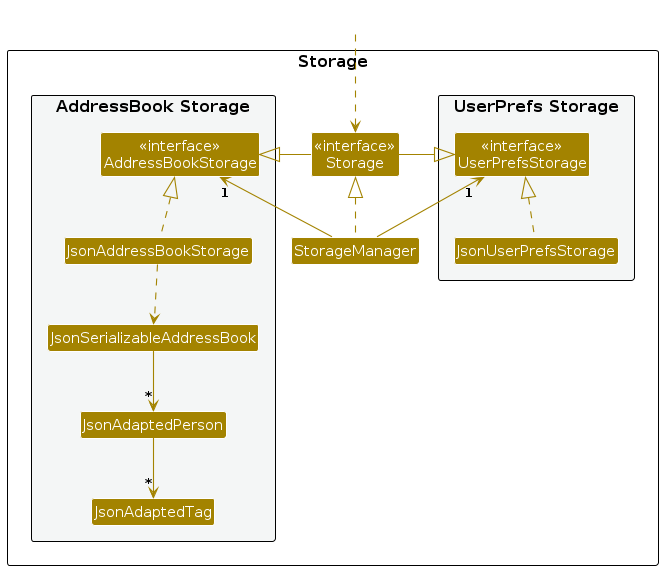
The Storage component,
- can save both address book data and user preference data in JSON format, and read them back into corresponding objects.
- inherits from both
AddressBookStorageandUserPrefStorage, which means it can be treated as either one (if only the functionality of only one is needed). - depends on some classes in the
Modelcomponent (because theStoragecomponent's job is to save/retrieve objects that belong to theModel)
Common classes
Classes used by multiple components are in the seedu.address.commons package.
Implementation
This section describes some noteworthy details on how certain features are implemented.
[Proposed] Undo/redo feature
Proposed Implementation
The proposed undo/redo mechanism is facilitated by VersionedAddressBook. It extends AddressBook with an undo/redo history, stored internally as an addressBookStateList and currentStatePointer. Additionally, it implements the following operations:
VersionedAddressBook#commit()— Saves the current address book state in its history.VersionedAddressBook#undo()— Restores the previous address book state from its history.VersionedAddressBook#redo()— Restores a previously undone address book state from its history.
These operations are exposed in the Model interface as Model#commitAddressBook(), Model#undoAddressBook() and Model#redoAddressBook() respectively.
Given below is an example usage scenario and how the undo/redo mechanism behaves at each step.
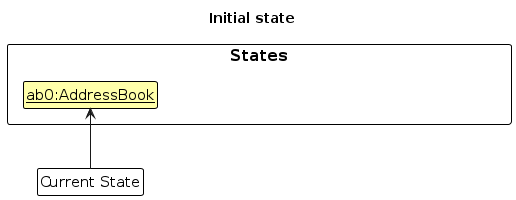
Step 1. The user launches the application for the first time. The VersionedAddressBook will be initialized with the initial address book state, and the currentStatePointer pointing to that single address book state.
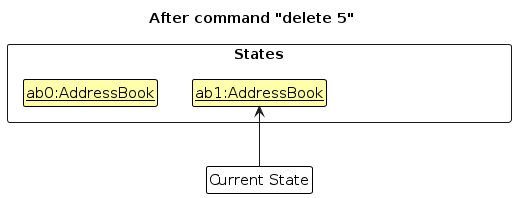
Step 2. The user executes delete 5 command to delete the 5th person in the address book. The delete command calls Model#commitAddressBook(), causing the modified state of the address book after the delete 5 command executes to be saved in the addressBookStateList, and the currentStatePointer is shifted to the newly inserted address book state.
Step 3. The user executes add n/David … to add a new person. The add command also calls Model#commitAddressBook(), causing another modified address book state to be saved into the addressBookStateList.
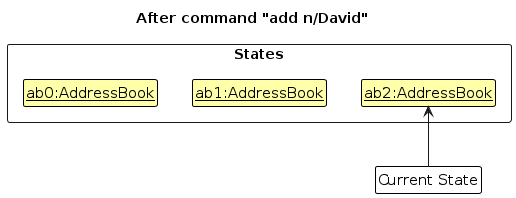
Note: If a command fails its execution, it will not call Model#commitAddressBook(), so the address book state will not be saved into the addressBookStateList.
Step 4. The user now decides that adding the person was a mistake, and decides to undo that action by executing the undo command. The undo command will call Model#undoAddressBook(), which will shift the currentStatePointer once to the left, pointing it to the previous address book state, and restores the address book to that state.
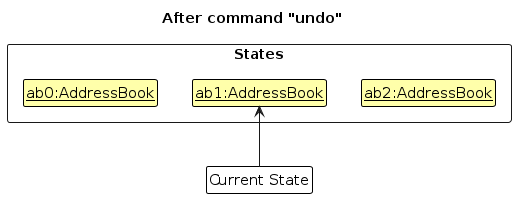
Note: If the currentStatePointer is at index 0, pointing to the initial AddressBook state, then there are no previous AddressBook states to restore. The undo command uses Model#canUndoAddressBook() to check if this is the case. If so, it will return an error to the user rather
than attempting to perform the undo.
The following sequence diagram shows how an undo operation goes through the Logic component:
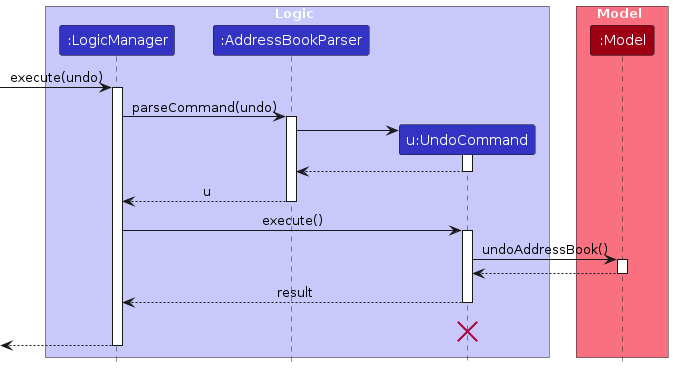
Note: The lifeline for UndoCommand should end at the destroy marker (X) but due to a limitation of PlantUML, the lifeline reaches the end of diagram.
Similarly, how an undo operation goes through the Model component is shown below:
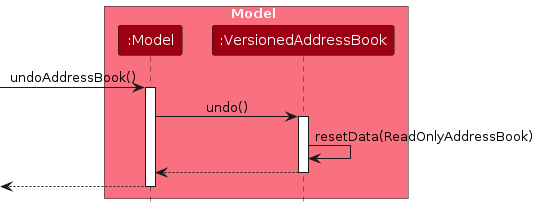
The redo command does the opposite — it calls Model#redoAddressBook(), which shifts the currentStatePointer once to the right, pointing to the previously undone state, and restores the address book to that state.
Note: If the currentStatePointer is at index addressBookStateList.size() - 1, pointing to the latest address book state, then there are no undone AddressBook states to restore. The redo command uses Model#canRedoAddressBook() to check if this is the case. If so, it will return an error to the user rather than attempting to perform the redo.
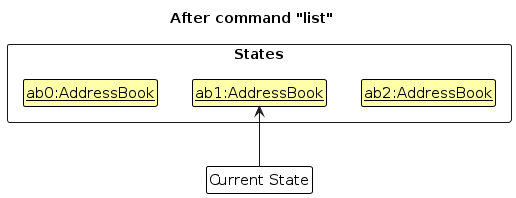
Step 5. The user then decides to execute the command list. Commands that do not modify the address book, such as list, will usually not call Model#commitAddressBook(), Model#undoAddressBook() or Model#redoAddressBook(). Thus, the addressBookStateList remains unchanged.
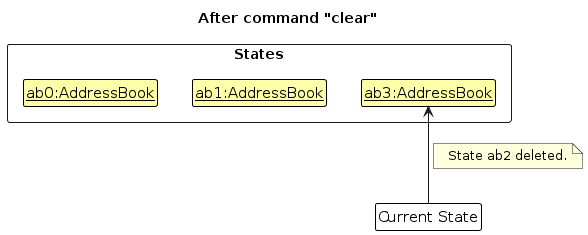
Step 6. The user executes clear, which calls Model#commitAddressBook(). Since the currentStatePointer is not pointing at the end of the addressBookStateList, all address book states after the currentStatePointer will be purged. Reason: It no longer makes sense to redo the add n/David … command. This is the behavior that most modern desktop applications follow.
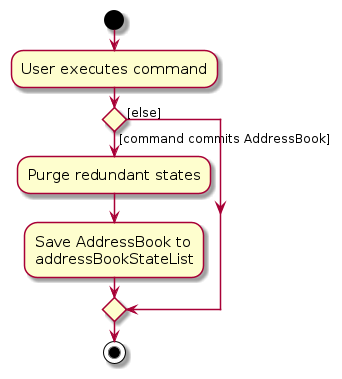
The following activity diagram summarizes what happens when a user executes a new command:
Design considerations:
Aspect: How undo & redo executes:
Alternative 1 (current choice): Saves the entire address book.
- Pros: Easy to implement.
- Cons: May have performance issues in terms of memory usage.
Alternative 2: Individual command knows how to undo/redo by itself.
- Pros: Will use less memory (e.g. for
delete, just save the person being deleted). - Cons: We must ensure that the implementation of each individual command are correct.
- Pros: Will use less memory (e.g. for
{more aspects and alternatives to be added}
[Proposed] Data archiving
{Explain here how the data archiving feature will be implemented}
Documentation, logging, testing, configuration, dev-ops
Appendix: Requirements
Product scope
Target user profile:
- NUS student needing to track peer details across modules, tutorials and lab
- has a need to manage a significant number of contacts and multiple commitments
- can type fast
- is reasonably comfortable using CLI apps
- prefers desktop apps to other types
- prefers typing to mouse interactions
Value proposition: NAB enables students to quickly organize and find saved contacts across multiple modules efficiently, while providing event management, tracking, and reminders.
User stories
Priorities: High (must have) - * * *, Medium (nice to have) - * *, Low (unlikely to have) - *
| Priority | As a … | I want to … | So that I can… |
|---|---|---|---|
* * * | student | add/save a peer's contact easily | easily contact them in the future |
* * * | student | view a peer's contact details | quickly access their information when I need to communicate or plan something with them |
* * * | student | delete a peer's contact | remove old information |
* * * | student | search for a specific contact by their name | quickly find their details without scrolling through the whole list |
* * * | organized student | categorise my peers according to context (e.g. modules, tutorial class, CCA, orientation group) | search for contacts in a specific grouping |
* * * | organized student | create an event for a commitment I have (e.g. module/project/CCA) linked to relevant contacts | keep track of events and remind/contact involved individuals |
* * * | organized student | delete an existing event for a commitment I have | remove any old or cancelled events so I don't mix up confirmed arrangements |
* * * | organized student | view all events related to a specific contact | easily view my arranged commitments with the specified contact |
* * * | efficient student | filter my peers by context | quickly find someone from a certain grouping (e.g. tutorial class) |
* * | student | update a peer's contact | always keep my contact information up to date |
* * | student | avoid contact duplication when adding | ensure I don't get confused from duplicate contacts |
* * | organized student | update an existing event for a commitment I have | always keep events updated in the case the details are changed |
* * | organized student | view all upcoming events related to my logical grouping (using tags) in one organised list | coordinate my group's schedule and make sure everyone knows what's coming next |
* * | proactive student | record a teammate's stated unavailability | avoid proposing a meeting during times they already told me they are busy |
* * | efficient student | import my existing contacts from a local file | easily load my existing contacts into NAB without adding them manually |
* * | efficient student | group more than 1 contact at once | efficiently group contacts all at once instead of 1 at a time |
* * | careful student | export the application's local data (contacts, details, commitments, etc.) | backup my data and transfer it between devices |
* * | forgetful student | add/attach notes to a contact when saving them | remember important details about my peers without relying on memory |
* * | forgetful student | edit notes that are attached to a contact | keep that contact's notes updated |
* * | forgetful student | delete notes that are attached to a contact | remove old or unnecessary notes that may be misleading |
* * | lazy student | pin contacts to the top of the list | easily access favourited contacts |
* * | lazy student | click on emails saved in my contacts | easily and quickly reach them via email without having to copy and paste their email address |
* * | new user | view all available commands | use the product immediately without having to consult an external guide |
* * | user | know what went wrong with my command | rectify immediately and continue using the product |
* | organized student | view my upcoming contact-linked events in chronological order | plan my weekly schedule and quickly see what's next while spotting potential overlaps |
* | organized student | archive contacts from the previous semester | keep my contact list clean after modules end |
* | lazy student | easily copy phone numbers of a chosen contact | reach them fast during coordinations |
* | seasoned student | create aliases for commands | customize my workflow and reduce repetitive command input |
* | seasoned student | reuse my previous commands | repeat actions quickly without retyping |
* | seasoned student | press Tab to autocomplete command keywords/prefixes | type faster and make fewer syntax mistakes |
Use cases (UC)
(For all use cases below, the System is the NAB and the Actor is the user, unless specified otherwise)
{More to be added}
Non-Functional Requirements
Portability:
- Should work on any mainstream OS as long as it has Java
17or above installed. - Should be packaged as a single JAR file not exceeding size of 100MB.
- Should be fully functional offline and must not depend on any remote server.
Scalability:
- NAB is intended for single-user use only and does not support multi-user scenarios.
Usability:
- GUI should work well (i.e. should not cause any resolution-related inconveniences to the user), for standard screen resolutions 1980x1080 and higher, and for screens scaled by 100% to 125%.
- GUI should remain usable (i.e. all functions can be used even if the user experieince is not optimal) for resolutions 1280x720 and higher, and for screens scaled by 150%.
Performance:
- NAB should be able to hold up to 1000 persons without a noticeable sluggishness in performance for typical usage.
Data Persistence:
- The data file should be stored locally in a human-editable text file, allowing advanced users to manipulate data directly by editing the file.
Data Synchronization:
- All modifications to data should be propogated and reflected in local data storage within 3 seconds.
Stability:
- All exceptions and errors should be handled gracefully by the application, i.e. there should not be any application crashes.
Fault Tolerance:
- Should be able to recover at least uncorrupted portions of local storage file or from a backup file should data file be corrupted.
Efficiency:
- A user with above average typing speed for regular English text (i.e. not code, not system admin commands) should be able to accomplish most of the tasks faster using commands than using the mouse.
Response time:
- Should not take more than 1 second to process commands and load data for up to 1000 persons and 30 tags cumulative in storage.
Data Integrity:
- When a contact is deleted, all events linked to that contact should also be removed to prevent orphaned data.
{More to be added}
Glossary
- NAB: NUS Address Book, the name of our desktop application.
- Contacts: A person (fellow student, friend, classmate, schoolmate) that a user has saved in NAB. A contact is typically (but not necessarily) associated with an event.
- Tag: A logical label attached to a contact for association-oriented lookups and logical groupings for easier management.
- Event: A contact-linked commitment or arrangement that the user has with one or more contacts (e.g. a project meeting, training session).
- Unavailability: A special type of event in NAB to indicate that a contact is unavailable during a time period, used to avoid scheduling conflicts.
- CLI: Command Line Interface is a text-based user interface that primarily uses commands and typed-inputs for user interaction (with the application), as opposed to GUI.
- GUI: Graphic User Interface is a graphics-based user interface that primarily uses mouse-clicks for user interaction (with the application), as opposed to CLI.
- Alias: An alternate name a user can assign to a command that allows easier command execution while maintaining command functionality.
- CSV: Comma Separated Values, a plain-text file format used to store tabular data. Specifically, this is to store the application data including contact names, phone numbers, tags, etc.
- Mainstream OS: Windows, Linux, Unix, macOS
- JavaScript Object Notation (JSON): A file format used to store and send data in a human-readable format.
- Java Archive (JAR): A file format used to compress multiple Java-related files into a single file for ease of distribution, deployment and execution.
Appendix: Instructions for manual testing
Given below are instructions to test the app manually.
Note: These instructions only provide a starting point for testers to work on; testers are expected to do more exploratory testing.
Launch and shutdown
Initial launch
Download the jar file and copy into an empty folder
Double-click the jar file Expected: Shows the GUI with a set of sample contacts. The window size may not be optimum.
Saving window preferences
Resize the window to an optimum size. Move the window to a different location. Close the window.
Re-launch the app by double-clicking the jar file.
Expected: The most recent window size and location is retained.
{ more test cases … }
Deleting a person
Deleting a person while all persons are being shown
Prerequisites: List all persons using the
listcommand. Multiple persons in the list.Test case:
delete 1
Expected: First contact is deleted from the list. Details of the deleted contact shown in the status message. Timestamp in the status bar is updated.Test case:
delete 0
Expected: No person is deleted. Error details shown in the status message. Status bar remains the same.Other incorrect delete commands to try:
delete,delete x,...(where x is larger than the list size)
Expected: Similar to previous.
{ more test cases … }
Saving data
Dealing with missing/corrupted data files
- {explain how to simulate a missing/corrupted file, and the expected behavior}
{ more test cases … }